Odo Head Spa offered by Odo Beauty Care Limited

Odo Beauty Care Limited Welcome to our first Odo Head Spa Salon located at 9F Pennington Com Bldg., 17 Pennington Street, Causeway Bay (Near to Regal Hotel, Hong Kong and above 7-11) 香港铜锣湾边寧顿亍 17号 边寧顿商业大厅厦电梯 9字 鄰近香港富豪酒店,7-11 樓上 TEL: 9010-1586 English and Japanese only (英/日语) Email: info@odo.com.hk BY APPOINTMENT ONLY 完全予約制 敬请电約

網頁

Powered By Blogger

2020年4月14日星期二

November 2019 Connector

OWASP
Connector
November 2019

COMMUNICATIONS


Letter from the Vice-Chairman

Dear OWASP Community, 

Preparation for next year's conferences is underway. I had the pleasure of meeting people from our community at a recent ISACA Ireland event where I had an OWASP stand. I also had lots of swag to give away, loads left which I plan to share out amongst the community. 

I was on a call recently with both WIA leadership and a number of individuals looking to broaden our diversity reach, forming DIA (diversity in AppSec). This was a positive call and I look forward to reviewing their proposal under the committee 2.0 operating model.

I'd like to thank our volunteers, chapter and project leaders for making OWASP what it is today. We wouldn't have a foundation without you. We always want to make things better, to this end, it would be great if you could fill out the following feedback form.

Thank you, 
Owen Pendlebury, Vice-Chairman

FROM THE EXECUTIVE DIRECTOR


As we wind down 2019, we are planning lots of new opportunities to get involved with OWASP next year. The current working draft of the 2020 Operating Plan can be found on our staging site for our new website which is planned to launch next month.
 
Some of the highlights for 2020:
  • Quarterly Town Hall meetings.
  • Two Project Summits - the first in February 2020
  • Pilot single-day AppSec Days worldwide to offer local training and community.
We are also set to further increase the transparency of the daily workings of OWASP through our Staff Projects page. The pages linked there will always be a work in progress; some of which today are still only templates but still a great resource to know what's going on at OWASP.

All of this which adds to our Global and Regional Events, ongoing local chapter support, and other member activities. Our plans are ambitious and we look forward to your continued support this and every month as we look to better secure the web.


OWASP Foundation Global AppSec Event Dates for 2020

Global AppSec Dublin, June 15 - 19, 2020
(Formerly known as AppSec EU)
Sponsorship is now available
Call for Papers & Call for Training December 2019
 
Global AppSec San Francisco, October 19 - 23, 2020
(Formerly known as AppSec US)
CFP &  CFT February 2020

** Visit our website for future announcements.**
NEW OWASP Project Summit - Winter 2020
February 2020 in Cancun, Mexico

 
The OWASP Foundation will host a three-day working session for FIVE selected projects in Cancun, Mexico, February 2020. Arrival day will be Wednesday the 19th and departures will be the 23rd. Projects must apply and then get selected to participate. The application process will require project meeting goals, work plans, key contributors, and expected attendance. The OWASP Foundation Officers Group will make the final selection. For more information click here. 

You can also email Emily Berman Global Events Director or Harold Blankenship Director of Technology and Projects.
Announcing a New Opportunity to become part of a Global AppSec Program Team
 
Conference Program Teams are constituted for each Global AppSec event and consists of members of OWASP members and staff. The selection of team members is based on subject-matter expertise and a balanced representation of the OWASP community. For planning purposes, team members shall reside on the continent of the Global AppSec for which they serve. Teams are constituted no later than six months prior to the Global AppSec event.

To apply to become a member of the Conference Program Team click here.


We are so excited to announce that both the London OWASP and WIA community have been asked to speak at BlackHat Europe 2019 on Wednesday 4 December at the EXCEL London.   Andra Lezza is leading the panel of women to "Share insights gained at different stages of their careers to help other women in the field."  Thank you, Andra, for leading the initiative and also to Sonya Moisset, Bibi Sanjarani, Katy Anton and Lauren Chiesa for volunteering to be part of the panel.  Also from the OWASP Community and a London Chapter Leader Sam Stepanyan and Paul Harragan.  Sam and Pau will be presenting a more in-depth demo on the OWASP Nettacker.  Good luck to all the speakers have a great conference.

I would like to encourage all of the OWASP community that will be attending BlackHat Europe to please make every effort to attend and support our fellow OWASP members Wednesday, 4 December 2019. (Click to view the schedule details.)

OWASP Members don't forget you are eligible for € 200.00 discount, email marketing@owasp.org for code to use when registering.


BlackHat Europe has extended an invitation to our London WIA community  to  lead a panel to "Share insights gained at different stages of their careers that could help other women in the field."  Thank you to Andra Lezza for leading this initiative and Sonya Moisset, Bibi Sanjarani, Katy Anton and Lauren Chiesa for volunteering to be part of the panel and to contribute.  Good luck I am sure your session will be a huge success.

BlackHat Europe 2019 London at EXCEL London
2019 December 2-5 
The OWASP Booth 1015
Business Hall December 4 & 5 
December 4, 10:30 AM - 7:00 PM
December 5: 10:00 AM - 4:00 PM

EVENTS 

You may also be interested in one of our other affiliated events:


REGIONAL EVENTS
Event DateLocation
German OWASP Day 2019 December 10, 2019 Karlsruhe, Germany
AppSec California 2020 January 21 - 24, 2020 Santa Monica, CA
OWASP New Zealand Day 2020 February 20 - 21, 2020 Auckland, New Zealand
OWASP Seasides March 3 - 5, 2020 Panjim Goa, India
SnowFROC 2020 March 5, 2020 Denver, CO
AppSec Morocco & Africa 2020 June 4 - 5, 2020 Rabat, Morocco

GLOBAL PARTNERSHIP EVENTS
Event Date Location
BlackHat Europe 2019 December 2 - 5, 2019 London

PROJECTS


As the foundation moves toward the migration of the OWASP web presence from the old wiki site to our new Github-hosted home, some of you may still have questions regarding what to move and how to move it. Essentially, if you have a chapter page or project page and you have not migrated it to the new website, that would be first. Steps on what to do and what is needed can be found at https://www2.owasp.org/migration There are also some minor instructions on the default project or chapter page itself. And if you are wondering where that page is located, you can go to https://github.com/OWASP and type your chapter name in the repository search bar. If your project or chapter is not there, contact me. Lastly, there are a number of excellent examples already done by other leaders (also linked on the migration page).

And, as a precaution, you should click over into the 'Settings' of your repository and then click the 'Collaborators & teams' link on the left menu and check to make sure that the usernames added to Collaborators match what you expect.  Having someone you do not know edit your web page without your knowledge is no longer the expected behavior.

Some resources, mostly for projects, have been uploaded to the OWASP Site Theme Repository and can be linked to via the /assets/image/common/<file> URL.

After your chapter or project page is done, there is a www-community repository which would include any files from the wiki that are not currently in a project or chapter or board/staff policy area.  For instance, there are pages there for GSoC and XSS and CSRF.  A list of the top pages that need to be migrated can be found attached to one of the TODO cards on our website migration Trello board which you are invited to join if you want to help migrate loose pages and/or perform some automation work.

Our current plan can be found on the Website Relaunch project page.

PROJECT ANNOUNCEMENT

As part of OWASP's participation in Google's Season of Docs, the ZAP project has had Nirojan Selvanathan (@sshniro)  working on API documentation.  The first iteration of the documentation is now live.  It includes Java, Python, and shell
example snippets all presented in a responsive and accessible design which we will continue to build on in the future.

Big thanks to Nirojan for his efforts on this wonderful initiative!
Congratulations and thanks to Google Open Source for helping to bring the open-source and technical writer communities together!

COMMUNITY

 
Welcome to our New OWASP Chapters

Colombo, Sri Lanka
Des Moines, IA
Harrisburg, PA
Louisville, KY
Monterrey, Brazil
Moscow, Russia


Contributor Corporate Members


*Ads and logos are not endorsements and reflect the messages of the advertiser only. *
Join us
Donate
Our mailing address is:
OWASP Foundation 
1200-C Agora Drive, #232
Bel Air, MD 21014  
Contact Us
Unsubscribe


This email was sent to *|EMAIL|*
why did I get this?    unsubscribe from this list    update subscription preferences
*|LIST:ADDRESSLINE|*

How To Install Metasploit In Termux

More information

  1. Hacker Search Tools
  2. Hacks And Tools
  3. Pentest Tools Nmap
  4. Growth Hacker Tools
  5. Hacking Tools Download
  6. World No 1 Hacker Software
  7. Install Pentest Tools Ubuntu
  8. Blackhat Hacker Tools
  9. Tools Used For Hacking
  10. Tools 4 Hack
  11. Pentest Tools Review
  12. Hack Tools
  13. Github Hacking Tools
  14. Pentest Tools For Mac
  15. Hack Tools Github
  16. Termux Hacking Tools 2019
  17. Hacker Tools 2019
  18. Hacking Tools Kit
  19. Pentest Tools Linux
  20. Hack Tools For Windows
  21. Hacking Tools For Beginners
  22. What Is Hacking Tools
  23. Hack Tool Apk No Root

Vsftpd Backdoor - Ekoparty Prectf - Amn3S1A Team

It's a 32bits elf binary of some version of vsftpd, where it have been added a backdoor, they don't specify is an authentication backdoor, a special command or other stuff.

I started looking for something weird on the authentication routines, but I didn't found anything significant in a brief period of time, so I decided to do a bindiff, that was the key for locating the backdoor quickly. I do a quick diff of the strings with the command "strings bin | sort -u" and "vimdiff" and noticed that the backdoored binary has the symbol "execl" which is weird because is a call for executing elfs, don't needed for a ftp service, and weird that the compiled binary doesn't has that symbol.


Looking the xrefs of "execl" on IDA I found that code that is a clear backdoor, it create a socket, bind a port and duplicate the stdin, stdout and stderr to the socket and use the execl:


There are one xrefs to this function, the function that decides when trigger that is that kind of systems equations decision:


The backdoor was not on the authentication, it was a special command to trigger the backdoor, which is obfuscated on that systems equation, it was no needed to use a z3 equation solver because is a simple one and I did it by hand.


The equation:
cmd[0] = 69
cmd[1] = 78
cmd[1] + cmd[2] = 154
cmd[2] + cmd[3] = 202
cmd[3] + cmd[4] = 241
cmd[4] + cmd[5] = 233
cmd[5] + cmd[6] = 217
cmd[6] + cmd[7] = 218
cmd[7] + cmd[8] = 228
cmd[8] + cmd[9] = 212
cmd[9] + cmd[10] = 195
cmd[10] + cmd[11] = 195
cmd[11] + cmd[12] = 201
cmd[12] + cmd[13] = 207
cmd[13] + cmd[14] = 203
cmd[14] + cmd[15] = 215
cmd[15] + cmd[16] = 235
cmd[16] + cmd[17] = 242

The solution:
cmd[0] = 69
cmd[1] = 75
cmd[2] = 79
cmd[3] = 123
cmd[4] = 118
cmd[5] = 115
cmd[6] = 102
cmd[7] = 116
cmd[8] = 112
cmd[9] = 100
cmd[10] = 95
cmd[11] = 100
cmd[12] = 101
cmd[13] = 106
cmd[14] = 97                    
cmd[15] = 118
cmd[16] = 117
cmd[17] = 125


The flag:
EKO{vsftpd_dejavu}

The binary:
https://ctf.ekoparty.org/static/pre-ekoparty/backdoor


More articles

PKCE: What Can(Not) Be Protected


This post is about PKCE [RFC7636], a protection mechanism for OAuth and OpenIDConnect designed for public clients to detect the authorization code interception attack.
At the beginning of our research, we wrongly believed that PKCE protects mobile and native apps from the so called „App Impersonation" attacks. Considering our ideas and after a short discussion with the authors of the PKCE specification, we found out that PKCE does not address this issue.
In other words, the protection of PKCE can be bypassed on public clients (mobile and native apps) by using a maliciously acting app.

OAuth Code Flow


In Figure 1, we briefly introduce how the OAuth flow works on mobile apps and show show the reason why we do need PKCE.
In our example the user has two apps installed on the mobile phone: an Honest App and an Evil App. We assume that the Evil App is able to register the same handler as the Honest App and thus intercept messages sent to the Honest App. If you are more interested in this issue, you can find more information here [1].

Figure 1: An example of the "authorization code interception" attack on mobile devices. 

Step 1: A user starts the Honest App and initiates the authentication via OpenID Connect or the authorization via OAuth. Consequentially, the Honest App generates an Auth Request containing the OpenID Connect/OAuth parameters: client_id, state, redirect_uri, scope, authorization_grant, nonce, …. 
Step 2: The Browser is called and the Auth Request is sent to the Authorization Server (usually Facebook, Google, …).
  • The Honest App could use a Web View browser. However, the current specification clearly advice to use the operating system's default browser and avoid the usage of Web Views [2]. In addition, Google does not allow the usage of Web View browser since August 2016 [3].
Step 3: We asume that the user is authenticated and he authorizes the access to the requested resources. As a result, the Auth Response containing the code is sent back to the browser.

Step 4: Now, the browser calls the Honest App registered handler. However, the Evil App is registered on this handler too and receives the code.

Step 5: The Evil App sends the stolen code to the Authorization Server and receives the corresponding access_token in step 6. Now, the Evil App can access the authorized ressources.
  • Optionally, in step 5 the App can authenticate on the Authorization Server via client_id, client_secret. Since, Apps are public clients they do not have any protection mechanisms regarding the storage of this information. Thus, an attacker can easy get this information and add it to the Evil App.

    Proof Key for Code Exchange - PKCE (RFC 7636)

    Now, let's see how PKCE does prevent the attack. The basic idea of PKCE is to bind the Auth Request in Step 1 to the code redemption in Step 5. In other words, only the app generated the Auth Request is able to redeem the generated code.
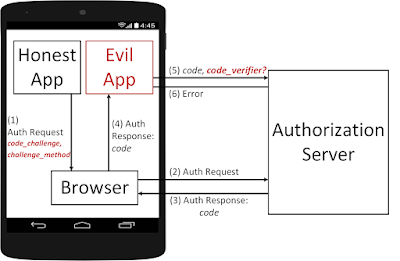

    Figure 2: PKCE - RFC 7636 

    Step 1: The Auth Request is generated as previosly described. Additionally, two parameters are added:
    • The Honest App generates a random string called code_verifier
    • The Honest App computes the code_challenge=SHA-256(code_verifier)
    • The Honest App specifies the challenge_method=SHA256

    Step 2: The Authorization Server receives the Auth Request and binds the code to the received code_challenge and challenge_method.
    • Later in Step 5, the Authorzation Server expects to receive the code_verifier. By comparing the SHA-256(code_verifier) value with the recieved code_challenge, the Authorization Server verifies that the sender of the Auth Request ist the same as the sender of the code.
    Step 3-4: The code leaks again to the Evil App.

    Step 5: Now, Evil App must send the code_verifier together with the code. Unfortunatelly, the App does not have it and is not able to compute it. Thus, it cannot redeem the code.

     PKCE Bypass via App Impersonation

    Again, PKCE binds the Auth Request to the coderedemption.
    The question rises, if an Evil App can build its own Auth Request with its own code_verifier, code_challenge and challenge_method.The short answer is – yes, it can.

    Figure 3: Bypassing PKCE via the App Impersonation attack
    Step 1: The Evil App generates an Auth Request. The Auth Request contains the client_id and redirect_uri of the Honest App. Thus, the User and the Authorization Server cannot recognize that the Evil App initiates this request. 

    Step 2-4: These steps do not deviate from the previous description in Figure 2.

    Step 5: In Step 5 the Evil App sends the code_verifier used for the computation of the code_challenge. Thus, the stolen code can be successfully redeemed and the Evil App receives the access_token and id_token.

    OAuth 2.0 for Native Apps

    The attack cannot be prevented by PKCE. However, the IETF working group is currently working on a Draft describing recommendations for using OAuth 2.0 for native apps.

    References

    Vladislav Mladenov
    Christian Mainka (@CheariX)
    Continue reading

    Ethical Hacking Platform For Penetration Testing | How To Hack The Invite Code: Join Hack The Box (HTB)

    Hack The Box

    Hack The Box (HTB) is a free platform available to ethical hackers to do a penetration testing for ethical hacking projects. It consist of different type of challenges that are updated constantly. Some of the challenges related to the real world scenarios and rest of the challenges related to learning towards a CTF style of challenges.
    Before joining to HTB, there is a simple task for you to prove your skills after that you'll able to create an account, and then you'll be able to access to your HTB Lab, where several challenges await for you to hack them. That's the beginning step for all of us to joining this. If you got success while hacking then you'll get points.

    Task For Joining The HTB

    Before joining the HTB, there is a task to hack invite code and paste that code in the code box for further registration to your account. You can complete a simple challenge to prove your skills, if you don't hack that then here is a short video below this content about hacking the invite code. Watch the video and hack the code!


    In this Video you'll learn about How to join Hack the box (HTB) in Kali Linux and other Linux Distributions.